
• About
    • Who We Are
    • What We Do
    • The Management Team
    • Global
  • Solutions
    • Microsoft Dynamics 365 CRM Development
    • Cloud Technology
    • Business Central Development
    • Data and AI
    • Enterprise Content Search
  • Services
    • AI Solutions
      • Getting Ready for AI
      • Dynamics 365 Agents
      • ECLEVA Agents
    • Business Systems Consulting
    • Enterprise Resource Planning (ERP)
      • Wiise Business Central
    • Customer Engagement (CRM) & Marketing Automation
    • Business Intelligence (Power BI)
    • Rapid Application Development (PowerApps)
      • HSE App by ECLEVA
    • Process Automation (RPA)
  • Sectors
    • Corporate & SME
    • Not-For-Profit
    • Construction
    • Financial Services
    • Education
    • Manufacturing
    • Government
  • Customer Stories
  • Insights
    • Blog
    • News
    • Videos
  • Contact
    • Contact ECLEVA
    • Customer Support
+61 2 9467 9300
Get in touch
  • About
    • Who We Are
    • What We Do
    • The Management Team
    • Global
  • Solutions
    • Microsoft Dynamics 365 CRM Development
    • Cloud Technology
    • Business Central Development
    • Data and AI
    • Enterprise Content Search
  • Services
    • AI Solutions
      • Getting Ready for AI
      • Dynamics 365 Agents
      • ECLEVA Agents
    • Business Systems Consulting
    • Enterprise Resource Planning (ERP)
      • Wiise Business Central
    • Customer Engagement (CRM) & Marketing Automation
    • Business Intelligence (Power BI)
    • Rapid Application Development (PowerApps)
      • HSE App by ECLEVA
    • Process Automation (RPA)
  • Sectors
    • Corporate & SME
    • Not-For-Profit
    • Construction
    • Financial Services
    • Education
    • Manufacturing
    • Government
  • Customer Stories
  • Insights
    • Blog
    • News
    • Videos
  • Contact
    • Contact ECLEVA
    • Customer Support
+61 2 9467 9300
Get in touch
  • About
    • Who We Are
    • What We Do
    • The Management Team
    • Global
  • Solutions
    • Microsoft Dynamics 365 CRM Development
    • Cloud Technology
    • Business Central Development
    • Data and AI
    • Enterprise Content Search
  • Services
    • AI Solutions
      • Getting Ready for AI
      • Dynamics 365 Agents
      • ECLEVA Agents
    • Business Systems Consulting
    • Enterprise Resource Planning (ERP)
      • Wiise Business Central
    • Customer Engagement (CRM) & Marketing Automation
    • Business Intelligence (Power BI)
    • Rapid Application Development (PowerApps)
      • HSE App by ECLEVA
    • Process Automation (RPA)
  • Sectors
    • Corporate & SME
    • Not-For-Profit
    • Construction
    • Financial Services
    • Education
    • Manufacturing
    • Government
  • Customer Stories
  • Insights
    • Blog
    • News
    • Videos
  • Contact
    • Contact ECLEVA
    • Customer Support
  • About
    • Who We Are
    • What We Do
    • The Management Team
    • Global
  • Solutions
    • Microsoft Dynamics 365 CRM Development
    • Cloud Technology
    • Business Central Development
    • Data and AI
    • Enterprise Content Search
  • Services
    • AI Solutions
      • Getting Ready for AI
      • Dynamics 365 Agents
      • ECLEVA Agents
    • Business Systems Consulting
    • Enterprise Resource Planning (ERP)
      • Wiise Business Central
    • Customer Engagement (CRM) & Marketing Automation
    • Business Intelligence (Power BI)
    • Rapid Application Development (PowerApps)
      • HSE App by ECLEVA
    • Process Automation (RPA)
  • Sectors
    • Corporate & SME
    • Not-For-Profit
    • Construction
    • Financial Services
    • Education
    • Manufacturing
    • Government
  • Customer Stories
  • Insights
    • Blog
    • News
    • Videos
  • Contact
    • Contact ECLEVA
    • Customer Support

Blog

Home Uncategorized 4 tips to help leaders manage Shadow IT
BusinessDigital transformationIT

4 tips to help leaders manage Shadow IT

October 8, 2020
4 tips to help leaders manage Shadow IT

In this video, ECLEVA’s CEO Patrick Northcott talks about the 4 tips to help Organisational Leaders manage Shadow IT.  

Shadow IT exists when employees use software applications and devices that are not under the control of the organisation. This significantly increases the organisation’s risk of data breaches and data loss.  

  1. Seek to understand why it exists. Determine employees’ awareness and satisfaction around existing business applications and list all applications they are using. Do this in conjunction with scanning your network to identify unknown devices and applications that have been introduced.
  2. Evaluate your exposure to Shadow IT. Certain apps may be good replacements for outdated systems whilst others may introduce huge risk.
  3. Develop clear guidelines around using own devices and external applications. The policy should educate users on the dangers of Shadow IT.
  4. Educate employees regularly on existing systems. A weekly or fortnightly tips and tricks email, helping them get more out of existing systems is a great initiative.

Talk to a technology expert, like ECLEVA to help your organisation manage Shadow IT. 
163
Shadow IT: What it is, why it exists and the 3 critical ways it puts your organisation at riskShadow IT: What it is, why it exists and the 3 critical ways it puts your organisation at riskOctober 8, 2020
6 key ways to get real value from your vendor relationshipsOctober 8, 20206 key ways to get real value from your vendor relationships
Categories
  • Blog (41)
    • AI (3)
    • Business (10)
    • Business Intelligence​ (3)
    • Digital Transformation (10)
    • IT (21)
    • Marketing (1)
  • News (18)
    • Business (11)
    • IT (5)
    • Sales (2)
  • Uncategorized (1)
  • Video (34)
    • Business (29)
    • Business intelligence (3)
    • Digital transformation (18)
    • IT (23)
    • Process automation (2)
Recent Posts
  • Reconciliation Reimagined: How Copilot and Business Central Transform Finance Operations
  • test
  • Business Central or CRM First? How Senior Leaders Can Make the Right Call
  • ECLEVA Presents: Real Ways AI Can Power Your Business
  • Developing Intelligent Supply Chains with Microsoft Dynamics 365 for Supply Chain Management


ECLEVA
© ECLEVA 2025.

All rights reserved.
Privacy Policy

Solutions

Business Systems Consulting

Customer Engagement (CRM) & Marketing Automation

Rapid Application Development (PowerApps)

Process Automation (RPA)

Business Intelligence (Power BI)

Sectors

Corporate & SME

Not-for-profit

Construction

Financial Services

Education

Contact

Address:

Level 11, 56 Berry Street,
North Sydney, NSW 2060

Phone:

+61 2 9467 9300

Address:

401-402, R M Arcade, Near Goverdhan Park, Taxsila School Road, Vastral, Ahmedabad 382418

Phone:

+91 98244 60130

Website:

www.ecleva.com

#integrio_button_694dce8b7b0d5 .wgl_button_link { color: rgba(255,255,255,1); }#integrio_button_694dce8b7b0d5 .wgl_button_link:hover { color: rgba(12,90,219,1); }#integrio_button_694dce8b7b0d5 .wgl_button_link { border-color: rgba(255,255,255,1); background-color: rgba(49,49,49,0.01); }#integrio_button_694dce8b7b0d5 .wgl_button_link:hover { border-color: rgba(255,255,255,1); background-color: rgba(255,255,255,1); }#integrio_button_694dce8b7b0d5.effect_3d .link_wrapper { color: rgba(255,255,255,1); }#integrio_button_694dce8b7d5d0 .wgl_button_link { color: rgba(255,255,255,1); }#integrio_button_694dce8b7d5d0 .wgl_button_link:hover { color: rgba(12,90,219,1); }#integrio_button_694dce8b7d5d0 .wgl_button_link { border-color: rgba(255,255,255,1); background-color: rgba(49,49,49,0); }#integrio_button_694dce8b7d5d0 .wgl_button_link:hover { border-color: rgba(255,255,255,1); background-color: rgba(255,255,255,1); }#integrio_button_694dce8b7d5d0.effect_3d .link_wrapper { color: rgba(255,255,255,1); }#integrio_button_694dce8b863af .wgl_button_link { color: rgba(49,49,49,1); }#integrio_button_694dce8b863af .wgl_button_link:hover { color: rgba(255,255,255,1); }#integrio_button_694dce8b863af .wgl_button_link { border-color: rgba(12,90,219,1); background-color: rgba(49,49,49,0.01); }#integrio_button_694dce8b863af .wgl_button_link:hover { border-color: rgba(12,90,219,1); background-color: rgba(12,90,219,1); }#integrio_button_694dce8b863af.effect_3d .link_wrapper { color: rgba(12,90,219,1); }#integrio_button_694dce8b88645 .wgl_button_link { color: rgba(49,49,49,1); }#integrio_button_694dce8b88645 .wgl_button_link:hover { color: rgba(255,255,255,1); }#integrio_button_694dce8b88645 .wgl_button_link { border-color: rgba(12,90,219,1); background-color: rgba(49,49,49,0); }#integrio_button_694dce8b88645 .wgl_button_link:hover { border-color: rgba(12,90,219,1); background-color: rgba(12,90,219,1); }#integrio_button_694dce8b88645.effect_3d .link_wrapper { color: rgba(12,90,219,1); }#integrio_soc_icon_wrap_694dce8bb6d31 a{ background: #0C5ADB; border-color: transparent; }#integrio_soc_icon_wrap_694dce8bb6d31 a:hover{ background: #ffffff; border-color: #0C5ADB; }#integrio_soc_icon_wrap_694dce8bb6d31 a{ color: #ffffff; }#integrio_soc_icon_wrap_694dce8bb6d31 a:hover{ color: #0C5ADB; }.integrio_module_social #soc_icon_694dce8bb6d8e1{ color: #ffffff; }.integrio_module_social #soc_icon_694dce8bb6d8e1:hover{ color: #ffffff; }.integrio_module_social #soc_icon_694dce8bb6d8e1{ background: #44b1e4; }.integrio_module_social #soc_icon_694dce8bb6d8e1:hover{ background: #44b1e4; }.integrio_module_social #soc_icon_694dce8bb6dba2{ color: #ffffff; }.integrio_module_social #soc_icon_694dce8bb6dba2:hover{ color: #ffffff; }.integrio_module_social #soc_icon_694dce8bb6dba2{ background: #0077b5; }.integrio_module_social #soc_icon_694dce8bb6dba2:hover{ background: #0077b5; }
Slide

In-Workshop
Step 1: Discover Your Business Challenges

We begin by exploring the parts of your organisation where work feels slow, repetitive, inefficient or difficult to scale. This includes operational bottlenecks, manual processes, disconnected systems, high-touch workflows, and areas where teams rely heavily on workarounds. The goal is to understand the real challenges behind your daily operations so we can identify processes that are strong candidates for improvement, automation or AI assistance.

Slide
In-Workshop
Step 2: Prioritise What Matters Most

Not all problems are equal. In this stage, your team collaboratively prioritises the challenges identified, ranking them based on business impact, urgency, and strategic importance.

This ensures the workshop stays focused on what truly matters — not theoretical use cases — and that every opportunity we identify is anchored to real, agreed business priorities.

Slide
Post-Workshop
Step 3: Map AI & Automation Opportunities

Following the session, ECLEVA translates your prioritised challenges into practical AI and automation opportunities that align to your current Microsoft environment, such as:

Microsoft 365 & Copilot
Dynamics 365 & Business Central
Power Platform (Power Apps, Power Automate, Power BI)
Each opportunity is assessed using a Value × Ease framework, clearly highlighting:

Quick wins
High-impact initiatives
Opportunities requiring more planning or investment
We then present these findings back to your team, walking you through the prioritisation, recommended sequencing, and logical next steps. You’ll receive a clear, visual prioritisation that makes decision-making easy.

Slide
Post-Workshop + Optional Next Phase
Step 4: Feasibility & Readiness Check

We complete a high-level feasibility and readiness check, covering:

Data availability and quality
System and integration readiness
Security, governance, and compliance considerations
Risks, blockers, and any preparation required
The outcome is a clear, actionable roadmap outlining recommended next steps, sequencing, and indicative effort.

If you choose to proceed, ECLEVA can support you through:

Detailed solution design
Proofs of concept or pilots
Implementation and change enablement
Always at your pace, aligned to your goals.

Slide
LEAVE WITH A CLEAR, ACTIONABLE ROADMAP
Step 5: Recommended Next Steps

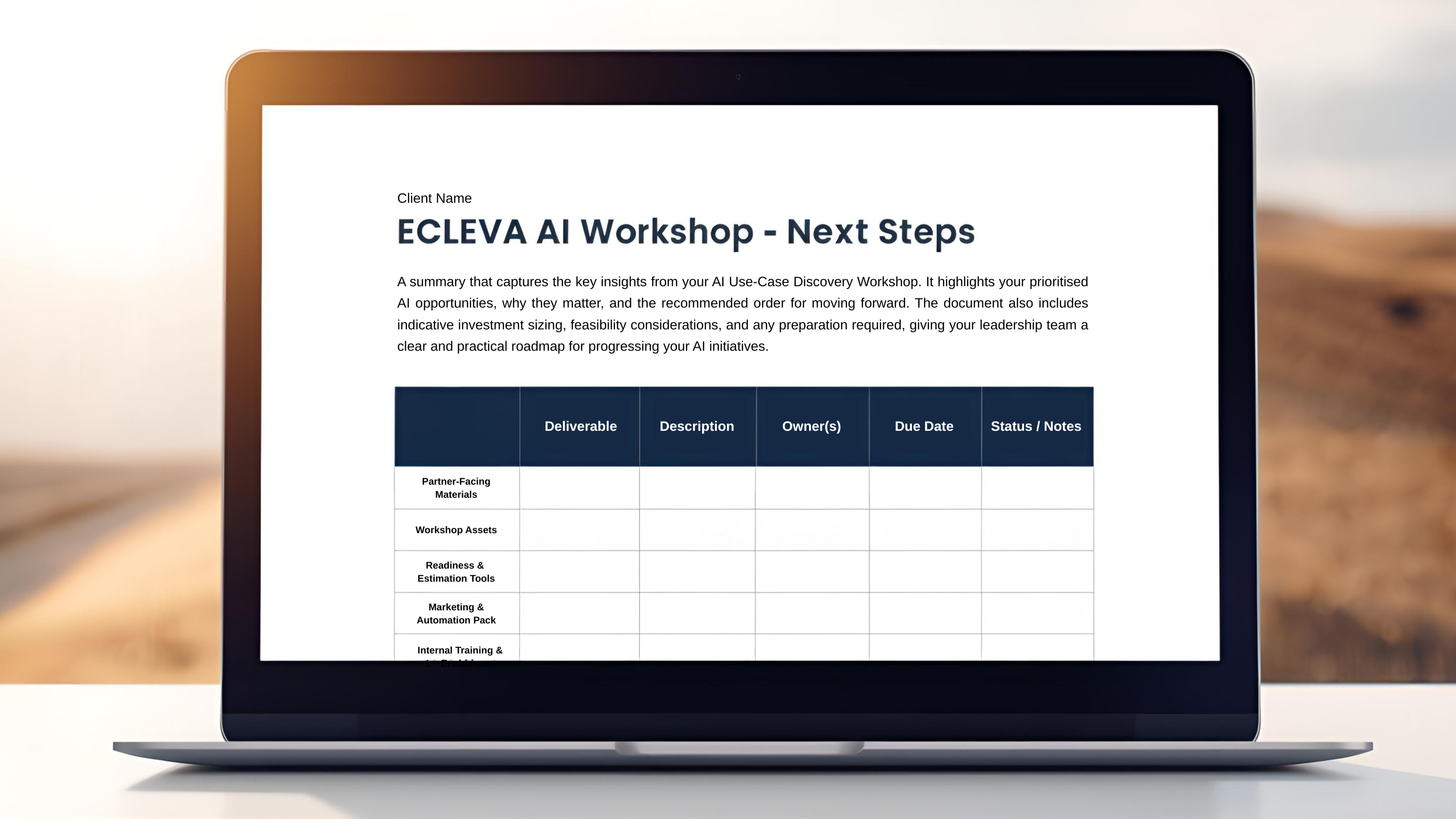
At the end of the workshop, we consolidate your insights into a clear, practical set of next steps. This includes prioritized opportunities, suggested sequencing, indicative effort levels and a path that aligns to your goals, technology landscape and operational priorities. You leave with an actionable starting point — something you can share with leadership or use to guide your internal planning.

previous arrow
next arrow