
Business Central or CRM First? How Senior Leaders Can Make the Right Call

The First Decision That Shapes Transformation
For many organisations ready to modernise, the question isn’t if they should move to Microsoft Dynamics 365—it’s where to start. Do you begin with Business Central (BC) to transform finance and operations, or with Customer Relationship Management (CRM) to empower sales, marketing, and service teams? Or do both at once?
There’s no universal answer—but there is a smart way to decide.
1. Start with Your Strategic Pain Points
The best place to start is not the technology, but the business problem.
-
If your leadership team is struggling with financial visibility, manual reporting, disjointed systems, or month-end chaos, then Business Central should lead.
-
If your biggest challenge is pipeline visibility, inconsistent customer engagement, or reactive service, then CRM should take priority.
Think of it this way:
Business Central gives you confidence in your numbers; CRM gives you confidence in your relationships.
2. Understand the Interdependence
Business Central and CRM work best when connected. Finance needs accurate sales data for forecasting; Sales needs invoice and customer balance data to manage accounts intelligently.
However, integrating both simultaneously requires clear process ownership and change readiness.
For some organisations, implementing both at once brings rapid transformation. For others, it introduces too much change fatigue and risk.
A staggered approach—starting with one and planning the other—often provides better adoption and ROI.
3. Assess Organisational Readiness
Consider these readiness factors:
|
Area
|
BC Readiness Indicators
|
CRM Readiness Indicators
|
|
Data
|
Clean financial data, chart of accounts mapped
|
Defined customer and lead data model
|
|
Processes
|
Mature finance workflows, clear approval chains
|
Documented sales, marketing, and service processes
|
|
People
|
Finance team open to change
|
Sales and service teams engaged and metrics-driven
|
|
Leadership Priority
|
Focused on profitability, compliance, and reporting
|
Focused on growth, relationships, and customer experience
|
If both teams are ready and leadership can sponsor both, a coordinated rollout can work—particularly if the CRM and BC use cases are clearly defined and limited in scope (e.g., core financials + sales pipeline tracking).
4. Consider Phasing for Momentum
A practical approach many organisations take:
Phase 1: Business Central (Finance Foundation)
-
Implement core financials, reporting, and automation.
-
Stabilise operations and ensure reliable business data.
Phase 2: CRM (Growth Enablement)
-
Leverage BC data to inform customer insights.
-
Drive marketing, sales, and service excellence using connected data.
Alternatively, some begin with CRM first to create early wins in revenue generation, then invest in BC to strengthen financial control and efficiency.
The key is to plan both journeys early, even if implementation is staggered.
5. Anchor the Decision in Business Outcomes
Technology is the enabler—but clarity of purpose is the differentiator.
Ask your leadership team:
Ask your leadership team:
-
What outcomes do we need in the next 12–18 months—growth, control, or scalability?
-
Where do inefficiencies cost us most—manual finance work or lost sales opportunities?
-
Which system’s transformation will build confidence and momentum across the business?
The answer to these questions usually reveals your starting point.
Final Thought
The most successful transformations don’t treat Business Central and CRM as separate projects—they view them as two halves of the same digital backbone.
Whether you start with one or both, your focus should be on building an integrated business platform that connects customers, people, and performance.
With the right roadmap, the decision of where to start becomes less about sequencing—and more about strategy.
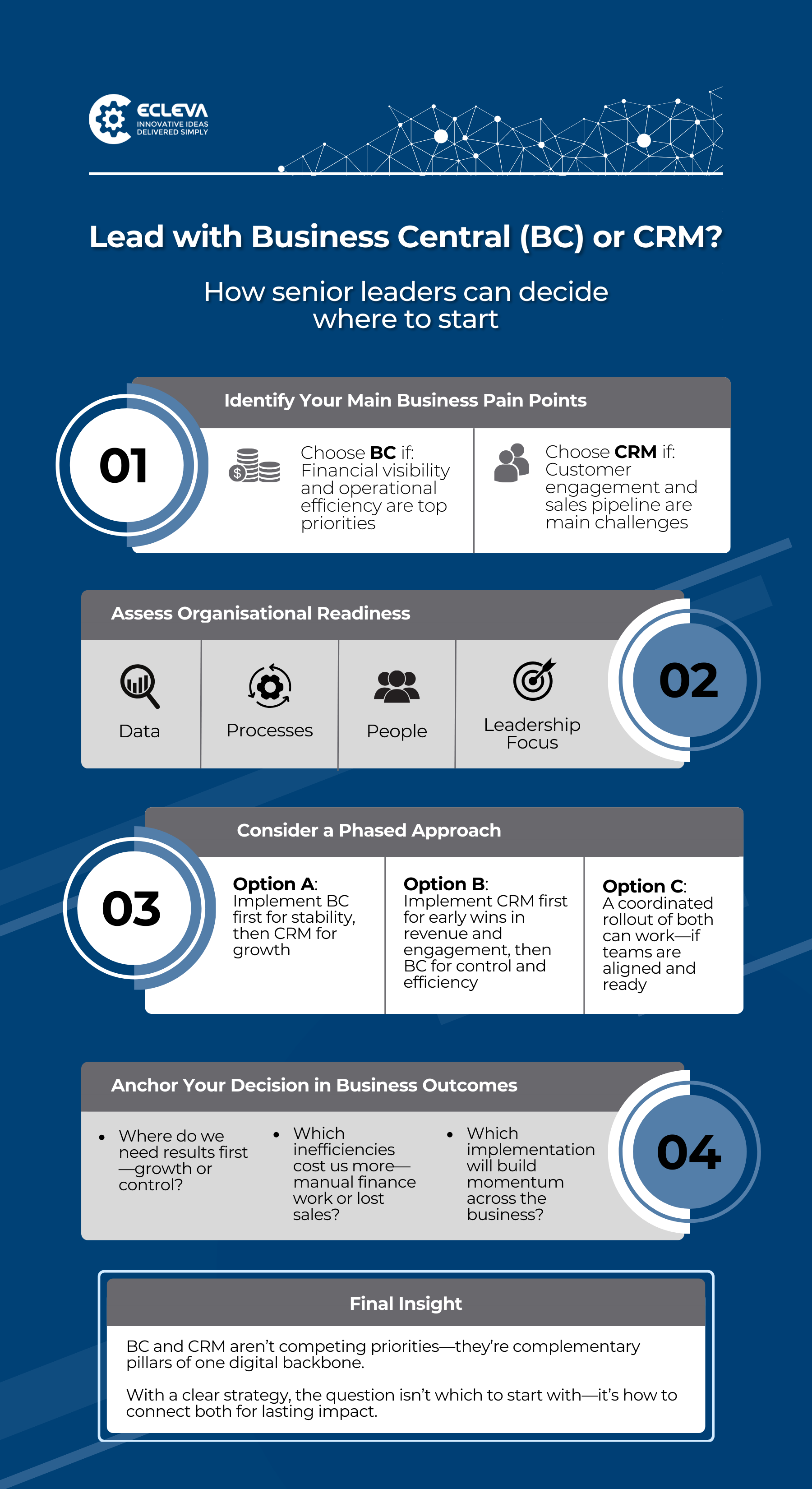
Ready to make your move? The infographic below outlines a clear roadmap to help you decide whether to begin your transformation with Business Central, CRM, or both.